



5.8
Commander Chess (2010)
Engage in modern combined arms warfare in this variant of Xianqi.
Rank: 26968
2 Players
15-30 Min
Age: 7+
Complexity: 3.00/5
 Add to Favorites
- Overview
- How to Play
- Videos
- Play Now
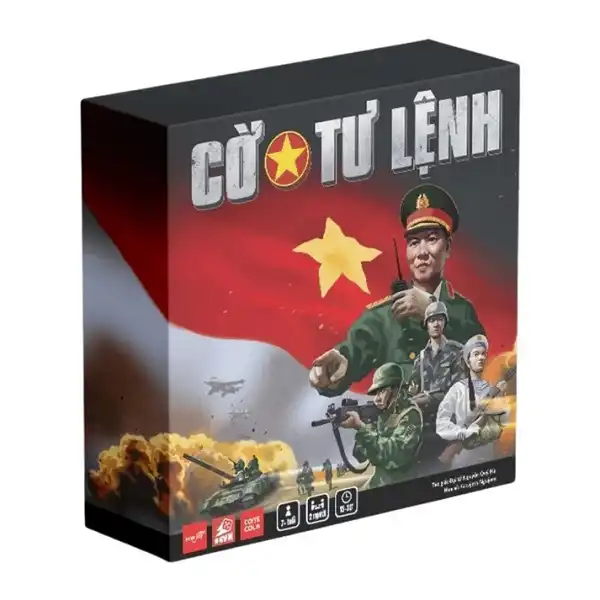
Commander Chess, or Cờ tư lệnh (literally "Chess Command") is a xiangqi variant created by Hải Quý Nguyễn.
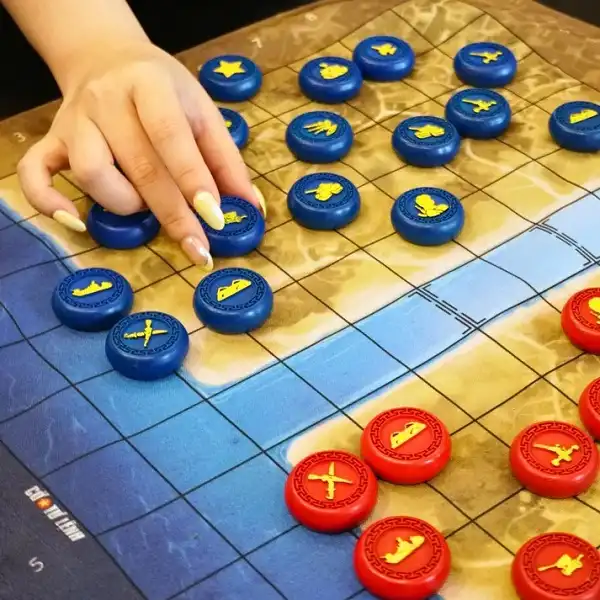
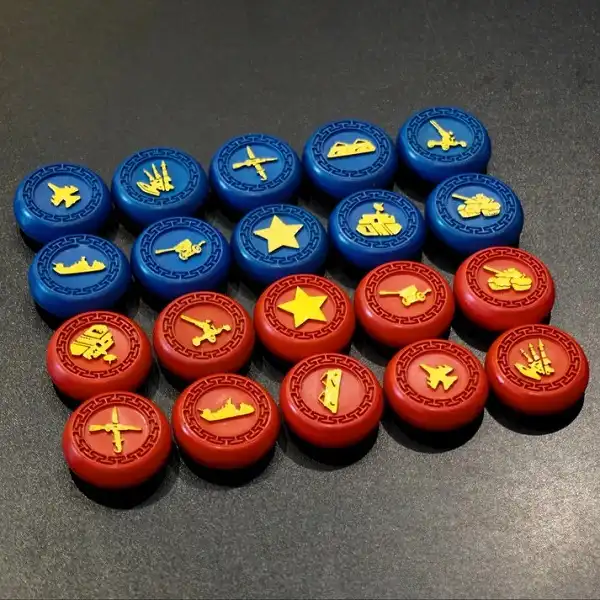
Cờ tư lệnh is played with 38 pieces (19 per player) on a board that is 11 lines wide and 12 lines long. As in xiangqi, it is played on the vertices of the grid. The board is divided into two lang territories by a river in the middle of the board. The three files on one side of the board form the sea. The object of the game is to capture the opponent's Commander, or all units of a single division of the opponent's army.
The pieces on both sides, with their abbreviations, movements, and rules, are:
- 1 Commander (C): moves any distance orthogonally; captures 1 point orthogonally; may occupy Headquarters; may not "see" the opposing Commander on an open file
- 2 Infantry (I): 1 point orthogonally
- 2 Tanks (T): 2 points orthogonally; may capture on sea squares it cannot enter, remaining stationary; carries C, In, or M
- 1 Militia (M): 1 point orthogonally
- 2 Engineer (E): 1 point orthogonally; carries all pieces, only across river; controls airspace 1 point any direction
- 2 Artillery (A): 1–3 points any direction; crosses river only at reefs, by attacking, or carried
- 2 Anti-aircraft gun (AA): 1 point orthogonally; may capture on sea squares it cannot enter; controls airspace 1 point any direction
- 1 Missile Rocket (R): 1–2 points orthogonally or 1 point diagonally; controls airspace as it moves
- 2 Air force (AF): 1–4 points any direction; may return to its departing point after capturing or carrying, unless capturing opposing Af; carries C, In, or M; destroyed immediately on passing through opposing airspace
- 2 Navy (N): 1-4 points any direction on sea, sea banks, and river banks; captures as it moves at sea; shoots 1–3 in any direction at land targets; controls airspace 1 point any direction
- 2 Commander Base (B): stationary and does not capture; may house only C; protects C, but not itself, from In, M, Aa, and Ms
General rules:
- Pieces capture as they move, and never jump, unless noted.
- Pieces can cross the river but not occupy sea points unless noted.
- Pieces which check the opposing Commander are promoted, gaining special abilities.
The Chinese xiangqi has generally been the most popular form of chess played in Vietnam. In fact, there is no traditional distinctively-Vietnamese chess game; which is partly what inspired Cờ tư lệnh.
Cờ tư lệnh is played on the vertices of an 11x12 "geographic" board similar to the 9x10 xiangqi board, with the addition of an ocean occupying files A–C and two "reefs" allowing all pieces to ford the river. It shares many features with wargames, including area denial, ranged attack, and unit cooperation.
Besides the fact that Vietnam has never had a distinctive regional form of chess, Nguyễn noted four complaints with xiangqi influenced the creation of Cờ tư lệnh:
1. Xiangqi promotes individualism and class conflict, particularly in the willingness of players to sacrifice low-level pieces to succeed.
2. Winning xiangqi is due more to luck than to intellect.
3. Xiangqi does not reflect the geography and history of Vietnam.
4. Xiangqi has many rule variantions, none of which are accepted by the entire community.
Each of these points is answered in Cờ tư lệnh:
1. Pieces cooperate through a "carrying" and area denial mechanics. As well, losing an entire class of piece loses the game, forcing protection of and cooperation among all classes.
2. Nguyễn believes the interactions between pieces and influence of geography necessitate more strategy and reduce the role of luck.
3. Besides the single river of xiangqi, there is an ocean, as well as "reefs" across the river, all of which interact with special piece rules. Besides the Vietnam-like geography, the pieces modern rather than ancient military structure.
4. By promoting Cờ tư lệnh educational programs, Nguyễn hopes to ensure that a single authoritative set of rules is used by all players.
Videos
Where to Play Commander Chess (2010)
Board Game Cafes and Clubs Have Commander Chess Near You
Play Online

Where to Buy Commander Chess (2010)

*We could earn commissions when you purchase through these links.

Related Games





Suggested Games







Xem Nhanh